First Week of College Checklist: What Freshmen Actually Need to Do
Quick answer
In your first week of college, handle four things: logistics (ID card, campus map, dining plan), accounts (school email, LMS, Wi-Fi, portal), academics (collect every syllabus and calendar every deadline), and people (professors, advisors, at least one classmate per course). Everything else can wait; these four cannot.
Drop your syllabus here
Every assignment, exam, and reading on your calendar in about 30 seconds. Free, no account.
PDF, Word, or a photo of a paper one. No syllabus handy? See a sample
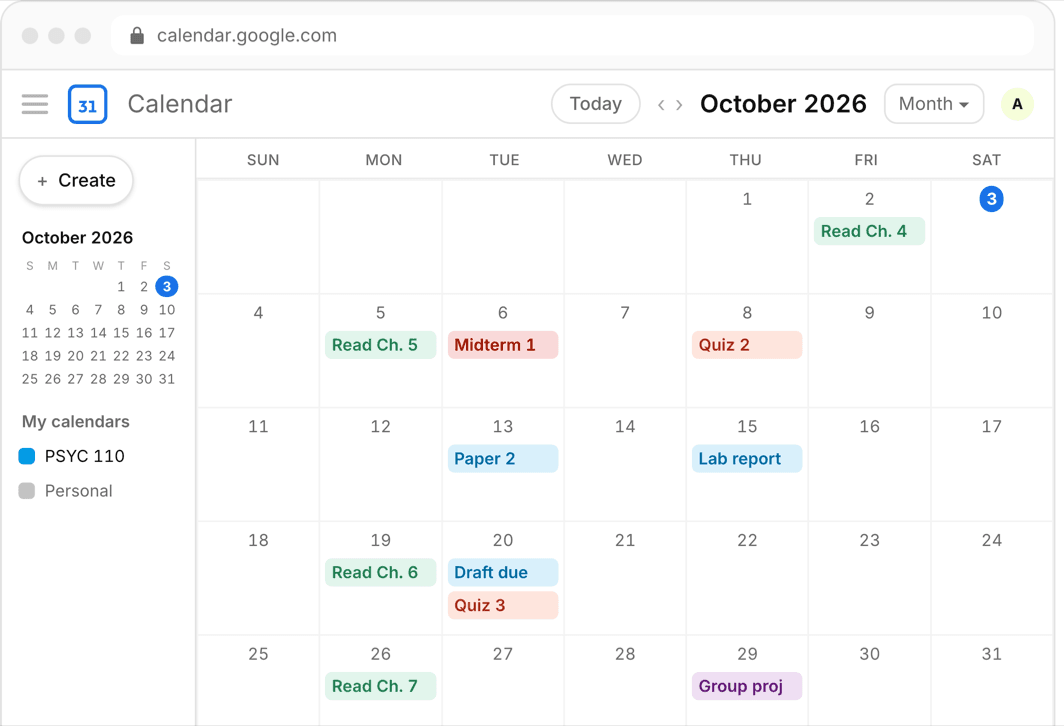
Your first week of college is a firehose: new campus, new people, new systems, and five professors each acting like theirs is your only class. You cannot do everything, and you do not need to. You need to do the specific things that get harder or more expensive to fix later.
This checklist is organized into four buckets — logistics, accounts, academics, and people. Work through them in that order. Most items take five minutes; skipping them costs hours in October.
Or skip all of it
Upload the syllabus. Get the calendar.
Every assignment and exam on Google, Apple, or Outlook in about 30 seconds. One syllabus free, no account, no card.
Logistics: the physical stuff
Campus logistics are easiest to fix in week one, when everyone else is confused too and every office has extended hours.
- Get your student ID card and learn what it unlocks — buildings, meals, gym, printing, local bus systems
- Walk your actual class schedule once before classes start, including finding the room, not just the building
- Confirm your dining plan works and learn the dining hall hours
- Locate the library, the health center, the registrar, and your academic department’s office
- Set up laundry payment (many schools use an app now) before you are out of clean clothes
- If you commute: do the commute once at the actual class time to test traffic and parking
Accounts: get every login working now
Every account problem is a five-minute fix in week one and a missed-deadline crisis in week six. Test all of them.
- School email — set it up on your phone; professors and administration only use this address
- LMS access (Canvas, Blackboard, Brightspace) — confirm every enrolled course appears
- Campus Wi-Fi on every device, including the printer setup if your school has campus printing
- Student portal — this is where registration, bills, and financial aid live; know your login
- Two-factor authentication — set it up with a method that works even when your phone is dead (backup codes)
- Any course-specific platforms the syllabus mentions: Gradescope, Top Hat, McGraw-Hill Connect, lab software
Academics: syllabi and the one-calendar rule
The academic side of week one comes down to one rule: every deadline from every syllabus goes into one calendar you actually check. Freshmen consistently underestimate this because high school announced every deadline repeatedly. College announces it once, in the syllabus, in week one — and then expects you to remember it in November.
- Collect every syllabus as a PDF or photo the day you receive it
- Extract every exam, paper, project, and quiz date into a single calendar
- Note each course’s grading breakdown so you know which assignments actually move your grade
- Write down each school-level deadline: add/drop, withdrawal, pass/fail election, tuition due date
- Buy or rent textbooks after checking the syllabus for which are truly required
- Skim the first week’s readings — week-one classes move faster than you expect
People: the relationships that compound
The people you meet in week one become your study partners, references, and safety net. You do not need to be outgoing; you need to be deliberate about a handful of contacts.
- Introduce yourself to each professor once — after class or in office hours; being a name instead of a face pays off all semester
- Find your academic advisor’s name and email, and book a check-in for week three or four
- Get one classmate’s contact info in every course — the person you text when you miss a class
- Say yes to dorm and orientation events for the first two weeks, even the awkward ones; friend groups form early
- Learn where tutoring and the writing center are before you need them
Turn five syllabi into one semester calendar
The one item on this list that freshmen most often abandon halfway is the one-calendar rule — because typing fifty dates out of five PDFs is genuinely tedious. It is also the item with the biggest payoff, since almost every freshman-year academic disaster starts with “I didn’t realize that was due.”
Classmaite exists for exactly this step: drop each syllabus at myclassmaite.com/try — PDF, Word doc, or a photo of a paper handout — and it pulls out every assignment, exam, and reading deadline in about 30 seconds, shows you the list to review, then syncs it to Google Calendar, Apple Calendar, or Outlook with reminders that hit harder for the assignments worth more of your grade. The first syllabus is free with no account, so you can finish the academics bucket of this checklist tonight.
Frequently asked questions
What is the biggest mistake freshmen make in the first week?
Treating it as a free week. Because little is due, freshmen skip the setup — syllabus deadlines, account logins, professor introductions — and then hit week four with a missed quiz, a locked account, and no one to ask for notes. Week one is setup week, not off week.
Should I go to office hours in the first week of college?
Yes, even with nothing to ask. A two-minute introduction — your name, your major or interest in the course — makes you a person to the professor. Common pattern: the students who show up in week one are the ones professors flex deadlines for in week ten.
How many clubs should I join in the first week?
Sign up for every mailing list that interests you at the activities fair — that costs nothing. Actually commit to one or two. Overcommitting in week one is the classic freshman trap; you can always add more in the spring once you know your real workload.
What should I do if I already hate one of my classes?
Give it two sessions, then act fast. Every school has an add/drop period — commonly the first one or two weeks — when you can swap courses with no penalty or transcript record. Check your registrar’s exact deadline; after it passes, your options get worse and can cost money.