The Add/Drop Period Explained: Deadlines, Refunds, and Swap Strategy
Quick answer
The add/drop period is the window at the start of each term — commonly the first one to two weeks — when you can add or drop courses with no grade, no transcript record, and usually a full tuition adjustment. After it closes, leaving a course becomes a withdrawal: a W on your transcript and a refund that shrinks on a sliding scale, often to zero within a few weeks. Exact dates vary by school, so check your registrar’s academic calendar.
Drop your syllabus here
Every assignment, exam, and reading on your calendar in about 30 seconds. Free, no account.
PDF, Word, or a photo of a paper one. No syllabus handy? See a sample
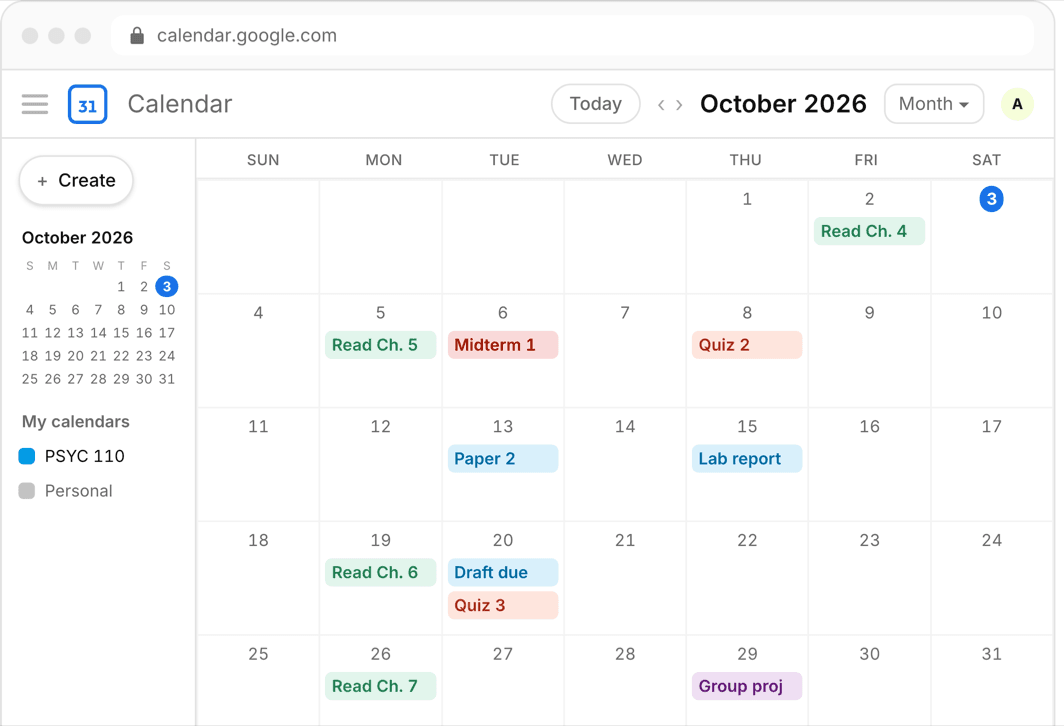
Add/drop is the escape hatch built into every semester — the short window when a schedule mistake costs nothing to fix. Used well, it lets you test-drive courses, upgrade professors, and dodge a doomed semester. Missed, it converts the same decision into transcript marks and lost tuition on a sliding scale most students have never looked at.
This guide covers how the period actually works, the deadline sequence that follows it, where the money is, and how to run a swap without falling behind in the course you land in.
Or skip all of it
Upload the syllabus. Get the calendar.
Every assignment and exam on Google, Apple, or Outlook in about 30 seconds. One syllabus free, no account, no card.
How add/drop works
During add/drop, your schedule is fully fluid: courses you drop vanish as if never taken — no grade, no W, no transcript record — and courses you add treat you as enrolled from day one. Most schools run this through self-service registration, no signatures needed, though adding after classes begin sometimes requires instructor permission.
The window is short. The common pattern is one week for adds and one to two weeks for penalty-free drops, though some schools stretch drops further; the exact dates sit in your registrar’s academic calendar and are worth putting in your own calendar with an alarm. One more mechanic that catches students: dropping below full-time status (usually 12 credits) during add/drop can affect financial aid, scholarships, housing, and insurance eligibility — a drop that takes you from 15 to 12 credits is routine, while one that takes you from 12 to 9 needs a call to the financial aid office first.
The deadline sequence: drop vs withdraw
Leaving a course means something different every week of the term. Know the sequence:
- During add/drop (≈ weeks 1–2): a drop — no grade, no transcript record, typically full tuition adjustment
- After add/drop, before the withdrawal deadline (commonly ≈ weeks 3–10, varies widely): a withdrawal — a W appears on your transcript, and refunds follow a sliding scale
- After the withdrawal deadline: usually stuck — you receive whatever grade you earn, barring documented hardship petitions
- A W is not a GPA event — it does not average into anything, and one or two Ws are generally unremarkable; a pattern of them can draw questions from grad programs
- Withdrawals can still count against financial-aid completion-rate requirements (satisfactory academic progress), so serial withdrawing has a cost beyond the transcript
Where the money is: the refund cliff
Tuition refunds are not linear — they fall off a cliff. A typical (school-varying) schedule looks like: 100% adjustment during add/drop, then perhaps 50% in week three, 25% in week four, and 0% from roughly week five on. Per-credit students who drop late pay most of the price of a course they will never finish.
This is why the drop decision has a financial clock, not just an academic one. If a course is going badly enough that withdrawal is plausible, the cheapest withdrawal is the earliest one — and the free one is the drop you make before add/drop closes. Waiting for the first exam grade to decide often means waiting past the refund. Check your bursar’s refund schedule the same day you check the registrar’s deadlines; they are different offices and different tables.
Swap strategy: how to trade up without falling behind
Add/drop is not just an eject button — it is a trading window. Playing it well is a small skill:
- Attend everything in week one, including courses you are only considering — syllabus day tells you the professor, the workload, and the grading structure
- Add before you drop: never release your seat in course A until your seat in course B is confirmed — seats do not wait
- Waitlists move most during add/drop as other students shuffle; join early and keep attending the target course so you are current when a seat opens
- When you add late, you own the catch-up: email the professor the same day, get the syllabus, and clear missed week-one work within a few days
- Verify aftermath every time: confirm the add and the drop both processed, your credit total still meets full-time status, and no tuition surprise appeared on your account
- Re-check your exam landscape after any swap — the new course’s midterms may collide with your existing ones in ways the old course’s did not
Decide with the syllabi, not with vibes
The add/drop clock means you are making keep-or-swap decisions in days, on limited information. The best information you have is the stack of syllabi — they tell you exactly what each candidate schedule costs in exams, papers, and weekly deliverables, and where the collisions are.
To see it fast: upload each syllabus to Classmaite at myclassmaite.com/try — PDF, Word doc, or a photo of a handout — and in about 30 seconds per course you get every assignment, exam, and deadline extracted onto one calendar you can review before committing. Comparing schedule A against schedule B becomes looking at two maps instead of re-reading ten PDFs, and once you commit, the winning schedule syncs to Google Calendar, Apple Calendar, or Outlook. First syllabus is free, no account. Add/drop rewards fast, informed decisions; this makes them fast and informed.
Frequently asked questions
Does dropping a class during add/drop show up on my transcript?
No. A drop during the add/drop period leaves no transcript record at all — no grade, no W, as if you never enrolled. That only changes after the period closes, when leaving a course becomes a withdrawal and a W appears. This is exactly why decisions made inside the window are so much cheaper.
Is a W on my transcript bad?
Mostly no. A W does not affect your GPA, and one or two are unremarkable to employers and most grad programs. A pattern of Ws every term can raise questions, and withdrawals count against the completion-rate math in financial aid’s satisfactory academic progress rules. A W is also almost always better than an F.
Can I add a class after the add deadline?
Sometimes, with permission — a late add typically requires the instructor’s sign-off and sometimes a dean’s or registrar’s approval, and gets harder every day as missed work piles up. If you need a late add, ask immediately and in person or by direct email; a same-week request with a catch-up plan succeeds far more often than a week-three one.
Will dropping a class refund my tuition?
During add/drop, usually yes — schedules typically adjust to what you are actually enrolled in. After the period, refunds follow a sliding scale that commonly hits zero within a few weeks (e.g., 50%, then 25%, then nothing). Flat-rate full-time students may see no change when swapping within the 12–18 credit band. Check your bursar’s refund schedule, which is separate from the registrar’s academic deadlines.