How to Pick College Classes: Requirements, Professors, and Schedule Shape
Quick answer
Pick classes in this order: (1) degree requirements first — check your degree audit and grab courses that satisfy multiple requirements, (2) research professors, since the instructor shapes a course more than the catalog description, (3) design the weekly schedule shape you can actually live with, and (4) register with ranked backups ready, because your ideal schedule rarely survives registration.
Drop your syllabus here
Every assignment, exam, and reading on your calendar in about 30 seconds. Free, no account.
PDF, Word, or a photo of a paper one. No syllabus handy? See a sample
Course registration rewards preparation and punishes improvisation. The students who end up with coherent schedules and good professors are the ones who showed up to their registration window with a ranked list and backups — not the ones who started browsing the catalog when their slot opened and seats were already vanishing.
Here is the system, in the order that matters: requirements, professors, schedule shape, workload balance, and the backup plan. Run it a week before your registration window and the window itself takes five minutes.
Or skip all of it
Upload the syllabus. Get the calendar.
Every assignment and exam on Google, Apple, or Outlook in about 30 seconds. One syllabus free, no account, no card.
Start with requirements, not the catalog
Browsing the full catalog first is how you fall in love with courses you cannot afford to take. Start narrow: open your degree audit (every school has one in the student portal) and list what you actually still need — major requirements, gen-ed categories, credit minimums, prerequisites for next year’s courses.
- Pull your degree audit and list unmet requirements before looking at any course descriptions
- Prioritize prerequisite chains: a course that unlocks three future requirements outranks an elective every time
- Hunt for double-dippers — courses that satisfy a major requirement and a gen-ed simultaneously are the highest-value picks on the board
- Check offering frequency: a required course offered only in fall must win over anything offered every term
- Book 15 minutes with your advisor with your draft list — they catch requirement misreads that cost students extra semesters
Research professors like your GPA depends on it
It does. The same course number taught by two different professors can be functionally two different courses — different workload, different grading, different amount you actually learn. Once requirements give you the what, professor research decides the which section.
- Ask students who took the course — one honest firsthand account beats twenty anonymous reviews
- Read Rate My Professors and campus equivalents for patterns, not scores: recurring specifics (“brutal grader, great lecturer”) are signal; single rants are noise
- Find the actual syllabus from a past term — many departments post them, and it tells you the workload and grading structure exactly
- Check grade distributions where your school publishes them; a course where 15% get As is a different commitment than one where 45% do
- For a required course with a notoriously bad instructor, consider taking it a different semester with a different one — timing is a tool
Design the schedule shape you can live with
A set of five individually good courses can still assemble into an unlivable week. Before finalizing, lay the candidate schedule on a weekly grid and look at its shape.
- Compressed (all classes Tue/Thu or MWF) buys free days for work or deep study, but makes each class day long and each absence expensive
- Spread-out keeps days short but fragments your week; commuters usually want compressed, easily-drained people usually want spread
- Respect your chronotype — do not schedule 8ams you will stop attending by October
- Leave gaps big enough to use: a 90-minute gap is a study block, a 30-minute gap is dead time
- Check meal windows and back-to-back sprints across campus before committing
- Balance the load mix: pair two heavy courses with lighter ones rather than stacking four exam-heavy courses in one term — and check that their midterms and finals do not all collide
Register with backups ready
Your ideal schedule is a draft; registration decides the final. Popular sections fill in minutes, so the plan has to include what happens when they do.
- Rank a backup section (different time or professor) for every course, plus one backup course per requirement category
- Know your registration window to the minute and log in early with course numbers ready — do not search during your window
- If a section is full, join the waitlist immediately and register the backup as a placeholder; movement is heaviest in the first week of the term
- Email the professor of a full section you genuinely need — instructor sign-offs and seat releases happen more than students think
- Keep attending the waitlisted section during week one so you are not behind when a seat opens
- Re-run the whole schedule-shape check after any swap — a backup section at a different hour can quietly reshape your week
Verify the workload before add/drop closes
The catalog told you the topic, the reviews told you the professor — the syllabus tells you the semester. Week one is your verification window: read every syllabus and confirm the combined workload actually fits, while you can still swap for free.
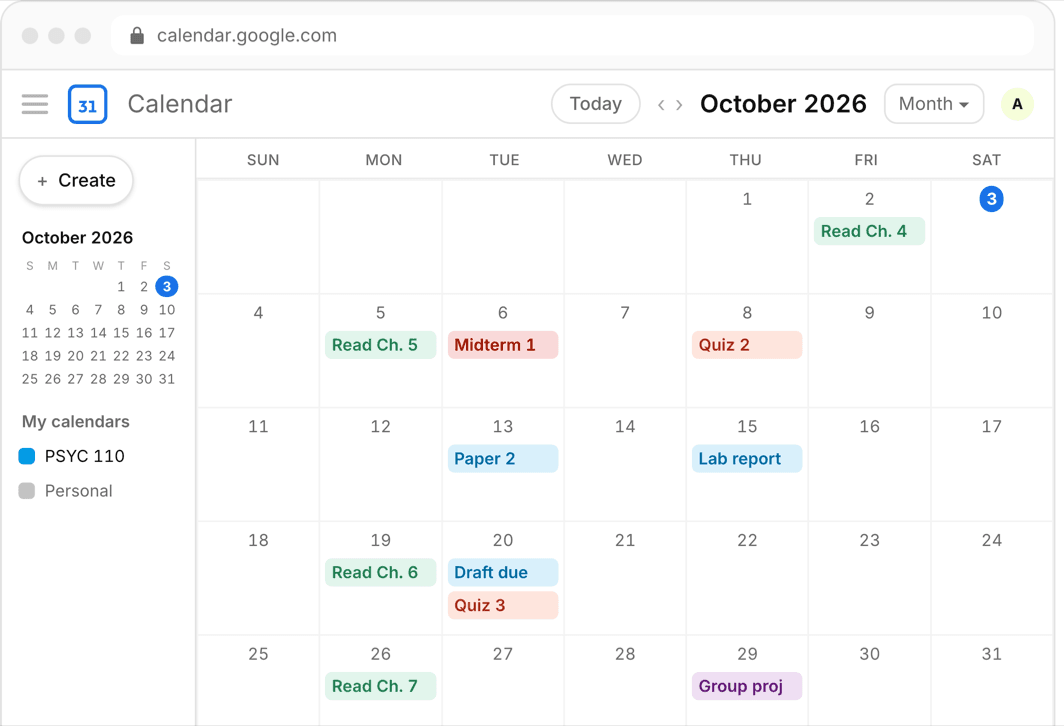
The fastest way to see it is on one calendar: upload each syllabus to Classmaite at myclassmaite.com/try (PDF, Word doc, or a photo) and in about 30 seconds per course it maps every assignment, exam, and deadline onto one view — so a schedule with four majors due in week ten reveals itself while add/drop is still open, not in week ten. First syllabus is free, no account needed. Picking classes well ends with checking the picks against reality.
Frequently asked questions
Should I pick classes for the professor or the topic?
For requirements, prioritize the professor — you must take the course either way, so take it from the best instructor available, even in a different term. For electives, weigh both: a great professor teaching an unfamiliar topic is often the sleeper best pick of a schedule, and a compelling topic taught badly usually disappoints.
How many hard classes should I take in one semester?
The common advising pattern is at most two known heavyweights per term, balanced with moderate and light courses. Difficulty stacks nonlinearly — three exam-heavy courses means three colliding midterm cycles and finals. Check the syllabi: the real question is whether the big deadlines land in the same weeks.
What should I do if every good section is full?
Waitlist immediately, register your backup as a placeholder, and email the professor explaining briefly why you need the course. Then keep checking daily through the first week of the term — add/drop churn frees up more seats than any other period. Persistent, polite, early beats lucky.