How Many Credits Should I Take? 12 vs 15 vs 18, Honestly
Quick answer
15 credits per semester is the standard load for graduating in four years (120 credits ÷ 8 semesters). 12 credits is the usual full-time minimum for financial aid but leaves you behind the four-year pace, and 18 is an overload that only makes sense with a light-syllabus mix or a strong track record. Using the common rule of 2–3 study hours per credit hour, 15 credits is roughly a 45–60 hour weekly commitment.
Drop your syllabus here
Every assignment, exam, and reading on your calendar in about 30 seconds. Free, no account.
PDF, Word, or a photo of a paper one. No syllabus handy? See a sample
Credits are the unit everyone registers in and almost nobody converts into hours. The result is students who would never sign up for a 60-hour work week signing up for one by accident — or students coasting at 12 credits without realizing they have quietly added a ninth semester and its tuition bill.
This guide does the conversion. What 12, 15, and 18 credits actually cost in weekly hours, what each choice does to your graduation timeline and financial aid, and the honest cases for taking less or more than the standard 15.
Or skip all of it
Upload the syllabus. Get the calendar.
Every assignment and exam on Google, Apple, or Outlook in about 30 seconds. One syllabus free, no account, no card.
The workload math: credits to hours
The standard conversion — used by accreditors, not just advice columns — is that one credit equals one hour of class time plus about two to three hours of outside work per week. So multiply your credit count by three or four to get the true weekly commitment.
The honest caveat: credits measure time in class, not difficulty. A 4-credit organic chemistry course and a 4-credit intro elective are the same on your transcript and nothing alike in your week. Always sanity-check the number against the actual syllabi — a 15-credit semester of lab sciences can outweigh an 18-credit semester of readings-and-discussion courses.
- 12 credits ≈ 36–48 hours/week total — a full-time-job-sized commitment
- 15 credits ≈ 45–60 hours/week — the four-year-graduation pace
- 18 credits ≈ 54–72 hours/week — a heavy overload; the top end leaves little room for anything else
The case for 12 credits
12 credits is the typical full-time minimum — the floor that usually keeps financial aid, scholarships, on-campus housing eligibility, and parents’ insurance intact (verify your specific aid terms; some scholarships require 15).
It is the right call when something else is consuming real hours: a 20+ hour work schedule, health issues, caregiving, a demanding sport, or a recovery semester after a rough term. The trade is pace: at 12 credits per term you accumulate 96 credits in eight semesters against a typical 120 needed — a two-semester gap you must close with summer courses, later overloads, or extra time and tuition. Choose 12 deliberately, with a written plan for making up the difference, not by default.
The case for 15 credits
15 is the default for a reason: 120 credits ÷ 8 semesters = 15. It is the pace that finishes a standard bachelor’s degree in four years with no summer classes and no overloads.
It is also a manageable load for most students most semesters — five 3-credit courses, roughly a 50-hour week all-in. If you have no strong reason to deviate, take 15 and spend your decision-making energy on which courses, not how many. A balanced 15 (two hard, two moderate, one light) beats both a brutal 15 and a padded 15.
The case for 18 credits — and when to overload
Overloading works when it is strategic and the mix is chosen for it. It fails when it is five hard courses plus wishful thinking.
- Good reasons: catching up to a four-year pace, adding a minor or double major, front-loading requirements before an internship-heavy or thesis-heavy year, graduating early to save a semester’s tuition
- Preconditions: you handled 15 comfortably last term, at most two of the six courses are known heavyweights, and your work hours are 10/week or fewer
- Check the price: many schools charge flat tuition for 12–18 credits, making the extra course effectively free — but some charge per-credit overload fees above a threshold; confirm before registering
- Check the rules: many schools require a minimum GPA or advisor sign-off above 17 or 18 credits
- Have an eject plan: know your drop deadline, and decide in advance which course you will drop if week four is drowning you
Whatever the number, see the load before you commit
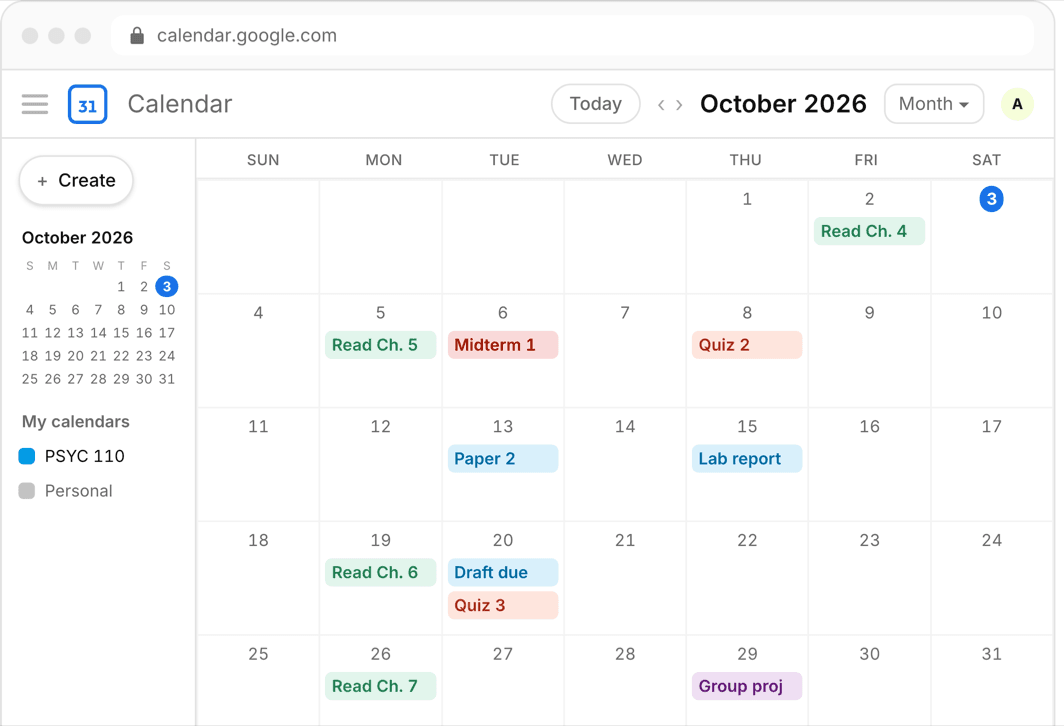
The credit count is a rough proxy. The real answer to “can I handle this schedule?” lives in the syllabi — how many exams, papers, labs, and weekly deliverables actually stack up, and in which weeks they collide. Two schedules with identical credit counts can have wildly different worst weeks.
A practical trick during add/drop: run your candidate schedule through Classmaite. Upload each syllabus at myclassmaite.com/try (PDF, Word doc, or screenshot) and in about 30 seconds per course you get every assignment, exam, and deadline laid out on one calendar — so you can see whether that 16-credit combination produces a survivable semester or a week with four majors due. The first syllabus is free with no account, and it turns the credits question from a guess about hours into a look at the actual map.
Frequently asked questions
Is 18 credits too much?
Not inherently — it depends on the mix and your track record. Six readings-based courses can be lighter than five lab sciences. Overload only if you handled 15 comfortably, no more than two of the courses are known heavyweights, and you know your drop deadline as an escape hatch.
Will taking 12 credits hurt my financial aid?
12 credits typically preserves full-time status, which most federal aid and many scholarships require — but policies vary: some scholarships require 15 credits, and dropping below 12 mid-semester can trigger aid recalculation. The common pattern is that 12 is safe and below 12 is not, but confirm with your financial aid office before finalizing, not after.
How many credits should a freshman take first semester?
Most advisors steer first-semester freshmen to 14–15 credits with a balanced mix — enough to stay on the four-year pace, without stacking five hard courses while you are still learning how college workload behaves. Save the 17–18 credit experiments for after you have one normal semester of data on yourself.
Do credits measure how hard a class is?
No — credits measure scheduled class time, not difficulty. A 3-credit course with weekly problem sets and three midterms costs far more hours than a 3-credit course graded on two essays. That is why you should always check the syllabus workload, not just the credit total, before finalizing a schedule.