How to Balance Work and College Without Burning Out
Quick answer
To balance work and school, do the hour math first: each credit hour demands roughly 2–3 hours of weekly study on top of class, so 15 credits is a 45–60 hour academic week. Research consistently finds up to about 15–20 hours of weekly work is manageable for most full-time students; beyond that, grades and completion rates tend to drop. Build the schedule around fixed anchors and cut work hours — not sleep — when the math stops working.
Drop your syllabus here
Every assignment, exam, and reading on your calendar in about 30 seconds. Free, no account.
PDF, Word, or a photo of a paper one. No syllabus handy? See a sample
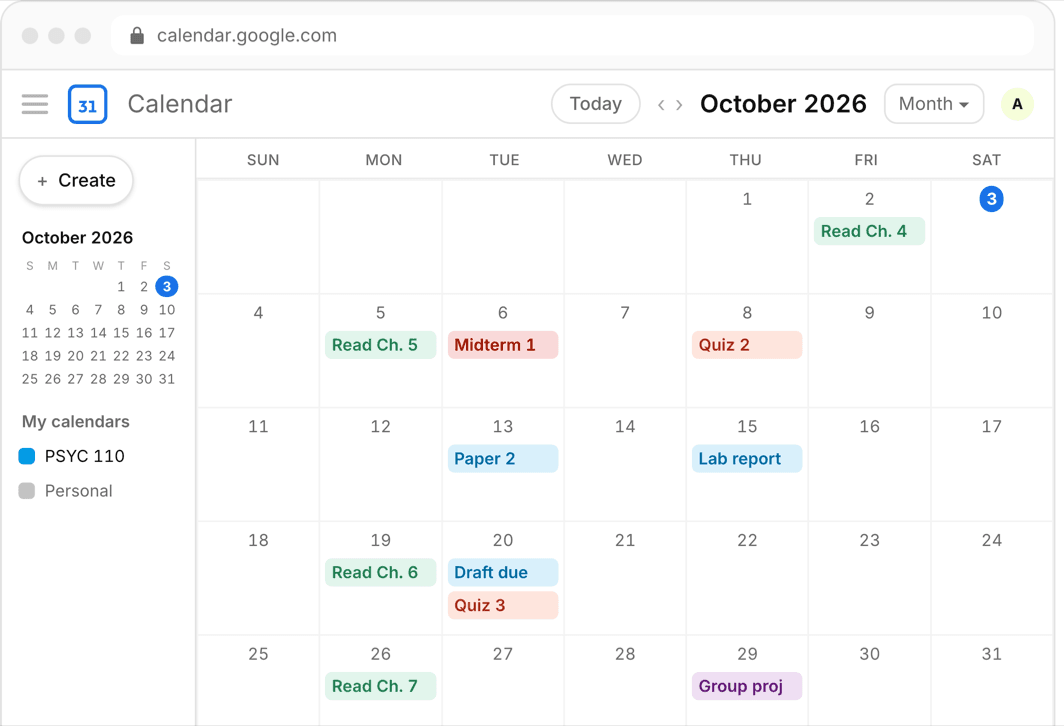
Half of full-time college students work. The ones who make it work are not tougher or better at time management than everyone else — they did honest arithmetic before the semester started, and they built a weekly structure that respects it. The ones who burn out usually skipped the math and tried to absorb the overflow with sleep.
This guide is that arithmetic, plus the schedule architecture that follows from it, plus the hard part nobody writes about: how to recognize when the load genuinely does not fit and something has to give.
Or skip all of it
Upload the syllabus. Get the calendar.
Every assignment and exam on Google, Apple, or Outlook in about 30 seconds. One syllabus free, no account, no card.
Do the hour math before the semester starts
Start with the standard rule: every credit hour is one hour in class plus roughly two to three hours of study per week. Fifteen credits is therefore a 45–60 hour academic commitment — a full-time job by itself. Now add work hours, commute, and the non-negotiables: sleep (49–56 hours), meals, hygiene, laundry.
A week has 168 hours. Run the numbers: 15 credits (say 50 hours) + 20 work hours + 52 sleep hours + 20 hours of eating, commuting, and life maintenance = 142 hours, leaving about 26 hours of true discretion — under four hours a day for everything else, including rest. At 30 work hours that margin nearly vanishes. This is why the research repeatedly lands on 15–20 weekly work hours as the ceiling where most full-time students still do fine, with grades and completion rates sliding beyond it. The math is not motivational; it is load-bearing.
Architect the week around fixed anchors
Working students cannot study “whenever” — there is no whenever. The schedule has to be architected: fixed anchors first, study blocks assigned to the gaps that remain, each with a standing job.
- Put classes and work shifts in the calendar first — these are immovable
- Identify every gap of 90 minutes or more; those are your primary study blocks
- Assign each block a standing job (“Tuesday 2–4: accounting problem sets”) so no time is lost deciding
- Use the small gaps (30–60 min) for shallow work: flashcards, readings, email — never save deep work for them
- Batch errands and life maintenance into one weekly slot instead of letting them leak everywhere
- Protect one genuinely free block per week; a schedule with zero recovery is a burnout schedule
Stack the deck when you choose classes and shifts
Half of work-school balance is won at registration, before the semester starts.
- Compress classes into fewer days (e.g., Tue/Thu) to create clean work days — or spread them out if long days drain you
- Check syllabi before committing: two courses with weekly labs plus heavy weekend shifts is a collision you can see in advance
- Prefer jobs with fixed schedules over variable ones; unpredictable shifts destroy study rhythm more than long ones
- On-campus jobs are commonly more flexible around exams, and some (front desk, monitoring roles) allow studying during quiet stretches
- Ask about exam-week flexibility in the interview, not in week ten
- If your aid package includes work-study, use it — those employers expect class to come first
Know the warning signs — and what to cut
Some semesters the math genuinely stops working. The skill is noticing early, and cutting the right thing.
Warning signs: sleeping under six hours regularly to keep up, grades slipping in more than one course at once, skipping classes for shifts, or feeling behind on Monday morning before the week starts. Any two of those together is the signal.
Cut in this order: discretionary commitments first, then work hours, then — only if work hours truly cannot move — course load, ideally before the withdrawal deadline so it is a clean decision rather than a forced one. Never cut sleep; it silently degrades both the studying and the working. And if the pressure is financial, talk to the financial aid office before dropping to part-time enrollment — dropping below full-time can affect aid, scholarships, and insurance, and there are often options (emergency grants, aid adjustments) students never hear about because they never ask.
Let the calendar carry the cognitive load
The invisible tax on working students is not hours — it is tracking. Holding five courses of deadlines in your head while switching between shifts and classes is exactly how the 20%-of-grade paper gets remembered three days out, at the start of a 25-hour work week.
This is worth automating. Classmaite takes each syllabus — PDF, Word doc, or a photo — and extracts every assignment, exam, and reading deadline in about 30 seconds, then syncs it to the calendar you already live by (Google, Apple, or Outlook), with reminders weighted by grade impact so the big deadlines start nagging you early enough to plan shifts around them. First syllabus is free at myclassmaite.com/try, no account. For a working student, the calendar is not a nice-to-have; it is the second brain that lets the first one rest.
Frequently asked questions
How many hours can I work during college without hurting my grades?
Research on working students consistently points to about 15–20 hours per week as the threshold for full-time students — at or below it, employment often has neutral or even slightly positive effects; above it, GPA and graduation rates tend to decline. Your personal ceiling depends on credit load and course difficulty, so run the hour math each semester rather than reusing last term’s number.
Is it better to work more hours and take fewer classes?
Sometimes — but do the full math first. Fewer credits per term means more terms, which means more total tuition and delayed earnings, and dropping below full-time status can affect financial aid, scholarships, and family insurance. For many students, trimming work to 15–20 hours while staying full-time nets out better than the reverse. Check with your financial aid office before choosing.
Should I tell my professors I work?
Yes, early and briefly — a short week-one email or office-hours mention, not an excuse in advance. Most professors are flexible with students who communicate before a conflict rather than after a missed deadline. It also makes any later request (an exam-week shift conflict, say) a follow-up instead of a surprise.