AI to Summarize Readings: Survive Reading-Heavy Courses Without Skipping the Point
Quick answer
Use AI summaries as a pre-read, not a replacement: summarize the assigned reading first to get the argument and structure, then read the important sections closely with that map in hand, and finish by having the AI quiz you. Summaries alone produce recognition, not understanding — enough for attendance, not for essays or exams.
Drop your syllabus here
Every assignment, exam, and reading on your calendar in about 30 seconds. Free, no account.
PDF, Word, or a photo of a paper one. No syllabus handy? See a sample
Reading-heavy courses run on an open secret: almost nobody does all the reading. Two hundred pages a week across three seminars isn’t a discipline problem, it’s arithmetic. The old coping strategies were skimming and skipping. AI summaries are the new one — and used naively, they’re just skipping with better production values.
Used strategically, though, summaries solve the actual problem, which was never “reading is hard” but “you can’t tell which 40 of the 200 pages deserve real attention.” The workflow in this guide — summarize first, read the load-bearing parts closely, quiz yourself after — gets you better comprehension than grinding through every page, in half the time.
Or skip all of it
Upload the syllabus. Get the calendar.
Every assignment and exam on Google, Apple, or Outlook in about 30 seconds. One syllabus free, no account, no card.
Why summary-only reading quietly fails
A summary gives you recognition: you’ll nod when the professor mentions the author’s argument. It doesn’t give you the evidence, the counterarguments, the texture — the things essays and seminar discussion actually run on. Students who only read summaries can name the thesis and nothing else, and it shows within one follow-up question.
There’s also a fidelity problem: AI summaries flatten nuance and occasionally misstate an author’s position, especially on dense theoretical texts. A summary is a map, and a map is not the territory. The fix isn’t avoiding summaries — it’s using them as maps.
Step 1: the pre-read summary
Before reading, get the shape of the piece. Upload the PDF to NotebookLM, or paste it into Claude or ChatGPT, and ask: “Summarize the central argument, the structure section by section, and the three most important passages.” Two minutes, and you now know what the text is trying to do.
This mirrors what strong readers were always taught — survey before you read. Comprehension improves dramatically when you know the argument before meeting the evidence, because every paragraph slots into a frame instead of arriving cold.
Step 2: read the load-bearing sections for real
Now spend your limited reading time where it pays: the introduction and conclusion, the sections your summary flagged as central, and anything your professor or syllabus emphasized. Read those closely — annotate, argue with the text, note quotes you might use in an essay.
Skim the rest with the map in hand. This is the honest version of the trade every student makes anyway: instead of uniformly shallow coverage of 200 pages, you get deep engagement with the 40 that will actually appear in discussion and essays.
Step 3: the quiz-yourself loop
Reading time only counts if it survives to Thursday’s seminar. After finishing, close everything and ask the AI to quiz you: “Ask me five questions about this reading — the argument, the evidence, and one about how it connects to last week’s text. Grade my answers.”
The misses tell you exactly which sections need a second look. This step takes ten minutes and is the difference between having read something and being able to say something about it.
Discussion and essay prep on top
- Before seminar: “Give me two discussion-worthy questions this reading raises, and one criticism a skeptical reader might make” — walk in with something to say
- For essays: pull quotes during your close read, not from the summary — summaries paraphrase, and essays need the author’s actual words, verified against the page
- Across weeks: NotebookLM shines here — with the whole course’s readings uploaded, ask how this week’s author would respond to last week’s
- Integrity check: using AI to understand readings is study help and fine in nearly every course; AI-written response papers are submitted work — check your syllabus’s AI policy
None of this works if you don’t know what’s due when
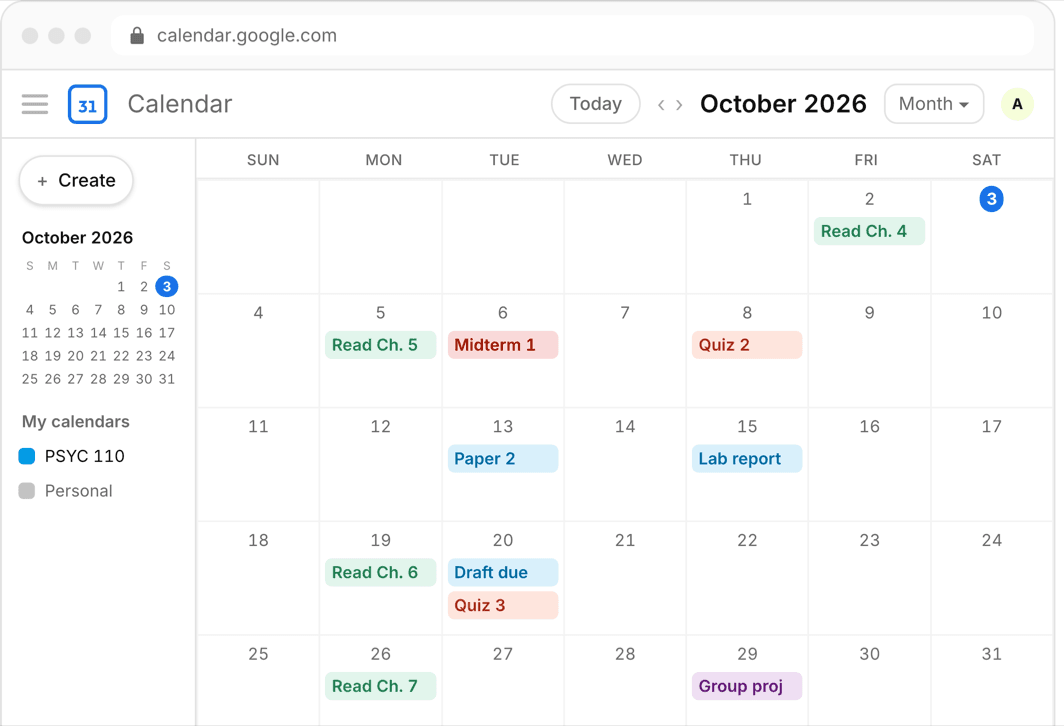
The strategy assumes you know Tuesday’s reading on Sunday, not Tuesday morning. Reading-heavy courses bury their schedules in dense syllabi — week-by-week page ranges that never make it into anyone’s calendar, which is how 80 pages sneak up on a Monday night.
Classmaite fixes that in one step: drop the syllabus in and it extracts every reading deadline alongside your assignments and exams, in about 30 seconds, then syncs them to your calendar with reminders. When the reading shows up three days out, the summarize-read-quiz loop has room to happen.
Frequently asked questions
Is it cheating to use AI to summarize readings?
Reading with AI assistance is study practice and allowed in nearly all courses — you’re preparing, not submitting. It becomes an issue when it feeds submitted work, like AI-written reading responses. Check the AI policy in your syllabus for anything you turn in.
What’s the best AI tool for summarizing academic readings?
NotebookLM is the standout for course readings: it works from your uploaded PDFs, cites where in the text its answers come from, and can work across a whole semester’s sources. Claude and ChatGPT handle pasted texts and quick summaries well; for long, dense PDFs, source-grounded answers with citations are worth a lot.
Can I rely on AI summaries for texts I never open?
For low-stakes background reading, a summary alone beats nothing. For anything that feeds an essay, exam, or discussion you’ll be graded on, no — summaries miss nuance, occasionally misstate arguments, and leave you without evidence or quotes. Summarize everything, but close-read what counts.