Spring Semester Goals: The January Reset That Actually Sticks
Quick answer
Effective spring semester goals come from fall’s evidence, not January optimism: diagnose exactly where fall’s points were lost, set two or three process goals that target those causes (behaviors on a schedule, not outcome wishes like “get a 4.0”), and install the supporting system — one calendar, a weekly review — during syllabus week. Spring also has its own calendar quirks, like a late start and a mid-semester spring break, that a good plan uses deliberately.
Drop your syllabus here
Every assignment, exam, and reading on your calendar in about 30 seconds. Free, no account.
PDF, Word, or a photo of a paper one. No syllabus handy? See a sample
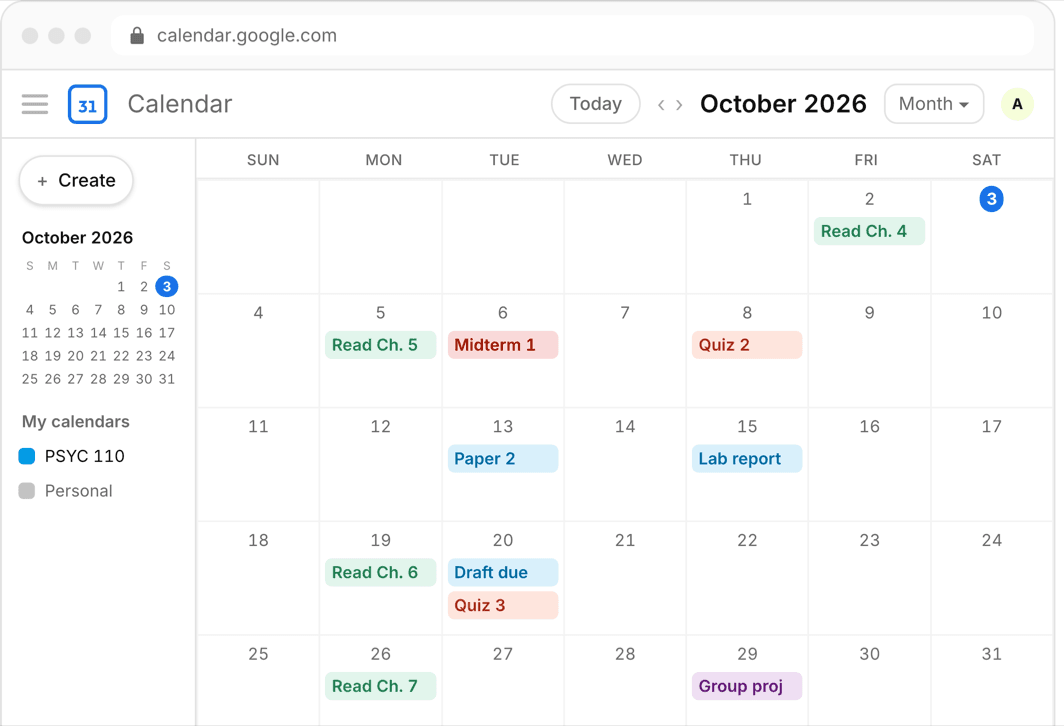
Spring semester is college’s built-in second chance: a full reset with fall’s lessons still fresh, arriving conveniently attached to New Year’s resolve. That resolve is also the trap. January goals in the “this semester everything changes” style fail on schedule by February, because they are aspirations about outcomes rather than changes to the machinery that produced fall’s outcomes.
The reset that sticks is smaller and colder: look at what fall actually did, change the specific system that failed, and let spring’s own calendar quirks work for you instead of against you. Here is how, step by step.
Or skip all of it
Upload the syllabus. Get the calendar.
Every assignment and exam on Google, Apple, or Outlook in about 30 seconds. One syllabus free, no account, no card.
Start with fall’s evidence, not January’s optimism
Before writing a single goal, spend 30 minutes as an auditor of your own fall. Pull up final grades and trace each one to its causes: which exams, papers, or missed assignments moved it. Then find the pattern — most students’ fall problems reduce to one or two root causes, repeated.
The common patterns: deadlines discovered late (a visibility problem), prep started too late (a scheduling problem), one underestimated course consuming everything (a calibration problem), or overcommitment outside class (a capacity problem). Name yours precisely. “I need to be more organized” is not a diagnosis; “I lost points in three courses to deadlines I forgot because they lived in five different syllabi” is — and it tells you exactly what to change.
Set process goals, not outcome wishes
Outcome goals — “get a 3.7,” “ace organic chemistry” — describe results you do not directly control, which is why they evaporate under pressure. Process goals describe behaviors on a schedule, which you do control, and which produce the outcomes. Convert every spring ambition into its process form, and cap the list at two or three:
- “Better grades in problem-set courses” → “Problem sets started the day assigned, finished 24 hours before due”
- “Stop cramming” → “Exam prep starts 7–10 days out, as calendar blocks placed when the exam date is known”
- “Stay on top of things” → “20-minute weekly review every Sunday at 7pm, already on the calendar as recurring”
- “Use professors more” → “One office-hours visit per course in the first three weeks, then whenever a grade dips”
- Two or three goals maximum — a five-goal reset is a zero-goal reset with better formatting
Install the system during spring syllabus week
January’s motivation is a launch window, not a power source — it will be gone by February, so use it now to build things that run without it. Spring syllabus week is the installation window: put every date from every syllabus into one calendar, place your recurring weekly-review block, and pre-commit exam-prep start dates. Each of these is a structure that keeps working when motivation stops.
Also apply fall’s calibration while changes are still free: if a course type burned you in fall, check spring’s syllabi for the same shape — the same weekly-deliverable load, the same exam-heavy grading — during add/drop, when swapping is still penalty-free. The reset includes the schedule itself, not just your habits.
Plan around spring’s calendar quirks
Spring is not a mirrored fall — it has its own shape, and a good plan uses it:
- The start is abrupt: no long autumn on-ramp — many courses hit full pace in week two, so the week-one setup matters even more than in fall
- Spring break lands mid-semester, usually around week eight or nine — right in midterm territory; check the syllabi early for whether exams and papers cluster just before it (common) and plan those weeks first
- Treat the break deliberately: decide in advance whether it is pure recovery or includes a set number of catch-up hours — the worst version is a week of ambient guilt that is neither
- The back half is a sprint: from spring break to finals often runs six or seven weeks with little slack, so anything that can be front-loaded before break should be
- Summer deadlines hide inside spring: internship applications, housing selection, fall registration, and financial aid dates all land mid-spring — put them on the same calendar as coursework, because they compete for the same weeks
Make the visibility fix take one evening
For most students, fall’s post-mortem points at visibility: the points were lost to deadlines that were published in week one and discovered in week nine. The corresponding spring fix — every date from every syllabus in one calendar — is the highest-value item in the reset, and the reason it failed last time is that manually transcribing five syllabi is tedious enough to abandon.
This January, let it take an evening instead: upload each spring syllabus to Classmaite at myclassmaite.com/try — PDF, Word doc, or screenshot — and every assignment, exam, grading weight, and reading deadline is extracted in about 30 seconds, ready to review and sync to Google Calendar, Apple Calendar, or Outlook with reminders weighted by grade impact. The first syllabus is free, no account needed. That is the reset, made structural: fall’s most expensive problem, closed before spring’s second week.
Frequently asked questions
What are good spring semester goals?
Good spring goals are process goals aimed at fall’s specific failure points: “weekly review every Sunday,” “exam prep starts 7–10 days out,” “every syllabus deadline in one calendar by end of week one,” “office hours once per course by week three.” Two or three of these, installed as calendar structures during syllabus week, beat any list of outcome wishes like “get a 4.0.”
Is spring semester harder than fall?
Not inherently — difficulty depends on your courses — but its shape trips people: an abrupt start with little on-ramp, midterms colliding with the run-up to spring break, and a six-to-seven-week sprint from break to finals. Students also carry more fatigue in spring. A plan that front-loads work before break and treats the back half as a sprint fits the shape.
How do I keep my spring goals past February?
Make them structural before January’s motivation fades: recurring calendar blocks, pre-committed prep dates, automated reminders — things that operate without daily willpower. Keep the list to two or three goals, and let the weekly review be the maintenance loop: twenty minutes each Sunday that catches drift while it is still one week deep instead of five.