How to Prepare for Next Semester: The Between-Terms Reset
Quick answer
To prepare for next semester: run a short honest review of last term (what worked, what broke, and why), fix the one system that failed most, handle logistics during the break (schedule confirmation, books, aid, work hours), and pre-build your week-one setup so syllabus week is execution rather than scramble. A few focused hours during break outperform any mid-semester rescue.
Drop your syllabus here
Every assignment, exam, and reading on your calendar in about 30 seconds. Free, no account.
PDF, Word, or a photo of a paper one. No syllabus handy? See a sample
The break between semesters is the only time you can work on your systems instead of inside them. During the term, every improvement competes with due dates; during break, nothing is due. That makes these weeks disproportionately valuable — and most students spend none of them on next term, then relearn last term’s lessons the hard way by week four.
You do not need the whole break. You need a few deliberate hours, split across four moves: an honest review, one system fix, early logistics, and a pre-built week one. Here is each, concretely — rest is still the break’s main job, and this plan leaves almost all of it intact.
Or skip all of it
Upload the syllabus. Get the calendar.
Every assignment and exam on Google, Apple, or Outlook in about 30 seconds. One syllabus free, no account, no card.
Step 1: Review last semester while it’s fresh
Do this in the first days of break, before the details blur. It takes 30 minutes with your grades and calendar open, and it is the input for everything else. Write actual answers — reflection that stays in your head rounds everything to “it was fine.”
- Where did each final grade come from? Identify the specific assignments or exams that moved each grade up or down
- When did you fall behind, and what triggered it — a collision week you didn’t see, a course you underestimated, a work-hours spike?
- Which deadline surprises happened, and would they have been visible on a calendar built in week one? (Almost always yes)
- What actually worked — the habits or setups you would keep even if no one told you to?
- What did each course cost in real weekly hours versus what you budgeted? This calibrates next term’s course-load decisions
- If you could send one sentence back to yourself at the start of last term, what would it say? That sentence is usually next term’s priority
Step 2: Fix one system, not seven
The review will surface multiple failures; break-time ambition will tempt you to fix all of them with an elaborate new life system. Resist it — pick the single failure that cost the most points, and change the system around it. One fix that survives contact with the semester beats seven that collapse in week three.
- Missed or last-minute deadlines → commit to the one-calendar rule: every date from every syllabus into a single calendar during week one, maintained weekly
- Chronic cramming → pre-commit exam-prep start dates (7–10 days out) on the calendar before the term begins
- Weeks that got away from you → adopt a 20-minute Sunday weekly review; put the recurring block in your calendar now
- Overcommitment → decide your drop rule in advance (e.g., “if I’m failing to keep up in week three, X is what goes”) while you are calm
- Wrong course-load calibration → use the real hour costs from step one when finalizing next term’s schedule
Step 3: Handle logistics while everything is quiet
Every administrative task is easier during break — no lines, no competing deadlines, and the good options are still available. Knock these out in one sitting:
- Confirm your registration: check for schedule changes, waitlist movement, and room/time updates since you registered
- If the review changed your mind about a course, act now — seats and professor options are better in December/January than during add/drop
- Source textbooks early: check syllabi or email professors for editions, and compare rental, used, digital, and library-reserve options before the campus-bookstore default
- Verify financial aid and billing: confirm aid disbursed, the bill is right, and any scholarship credit-hour requirements match your schedule
- Set work hours for the term now, using last semester’s real availability — not the optimistic version
- Book recurring appointments (advisor check-in, therapy, tutoring) before the calendar fills
Step 4: Pre-build week one
Syllabus week is the highest-leverage week of the semester, and it goes better walked into with the setup done. In the last days of break, spend an hour pre-building it:
- Create your semester calendar now with what you already know: class times, work shifts, school-level dates (add/drop deadline, breaks, finals week) from the academic calendar
- Set up folders — digital and physical — per course, empty and ready
- Download syllabi that professors post early; some appear on the LMS a week or more before classes
- Walk or map your new class schedule, especially new buildings and back-to-back transitions
- Schedule your week-one tasks as calendar events: “extract dates from each syllabus,” “intro email or office-hours visit per professor,” “confirm all LMS access”
- Reset the machinery: clear last term’s files into an archive folder, update passwords that will expire, charge and test whatever you take to class
Make the calendar step take one evening
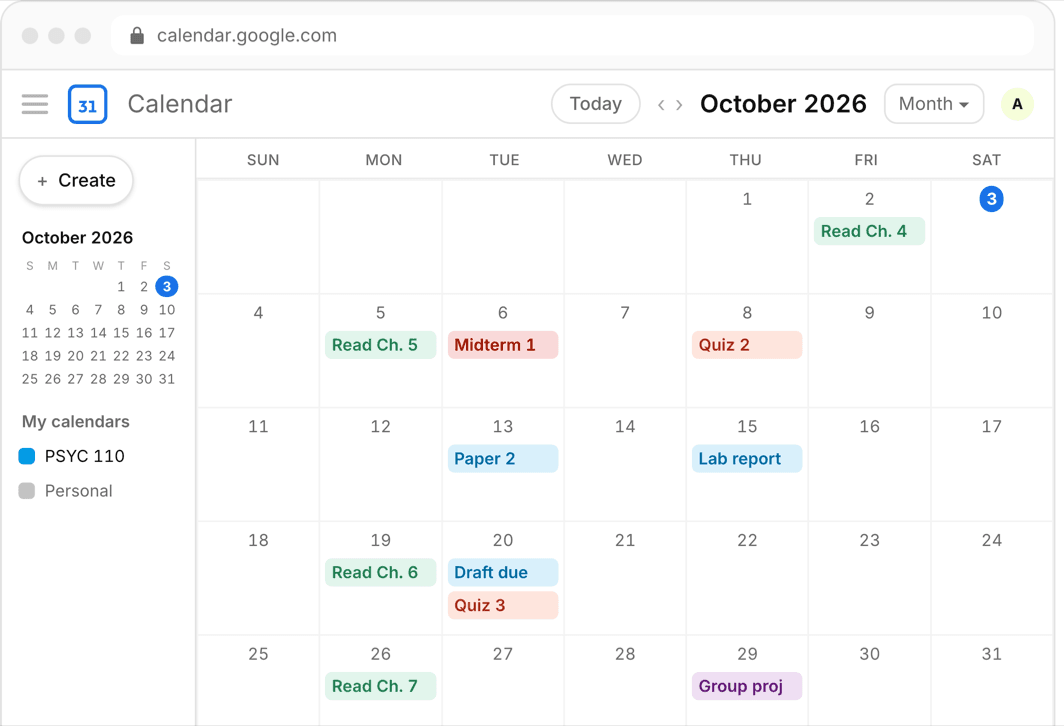
If the review showed what most students’ reviews show — that the expensive surprises were all visible in the syllabi from day one — then the single highest-value item in this whole reset is the one-calendar rule. Its historical failure mode is tedium: manually typing fifty dates from five PDFs is exactly the chore that gets abandoned mid-way.
Classmaite removes the tedium: as each syllabus arrives, upload it at myclassmaite.com/try — PDF, Word doc, or a photo — and every assignment, exam, grading weight, and reading deadline is extracted in about 30 seconds, ready to review and sync to Google Calendar, Apple Calendar, or Outlook with reminders weighted by grade impact. Do the early-posted syllabi over break and the rest as they land in week one, and the system you promised yourself in step two is running before the semester can test it. First syllabus is free, no account needed.
Frequently asked questions
When should I start preparing for next semester?
Two touchpoints: the first days of break for the review (while last term’s details are fresh) and the final week of break for logistics and week-one setup. The middle of break is for actually resting — a few hours at each end is the entire time cost, and recovery is itself part of preparing.
What should I buy before the semester starts?
As little as possible until syllabi confirm what is required. Textbook editions change, professors drop listed books, and many readings end up posted free on the LMS or library reserves. Buy what early-posted syllabi or a professor’s email confirms; wait on the rest until week one. The exceptions are basics you know you need — chargers, notebooks, a planner or calendar setup.
How do I not fall back into old habits next semester?
Change one system, make it structural, and install it before the term starts. Structural means it exists outside your intentions: a recurring Sunday review block already on the calendar, exam-prep start dates pre-committed, deadlines auto-reminded. Willpower-based resolutions lose to week-five workload; structures that run without daily decisions survive it.