The Transfer Student Checklist: Credits, Advising, and Starting Over Smart
Quick answer
The transfer student checklist in order: audit your official credit evaluation line by line against your new degree requirements, appeal any course that transferred as useless elective credit, meet your new advisor before registration, confirm financial aid and enrollment logistics, and rebuild your academic systems — because every deadline, portal, and policy just changed.
Drop your syllabus here
Every assignment, exam, and reading on your calendar in about 30 seconds. Free, no account.
PDF, Word, or a photo of a paper one. No syllabus handy? See a sample
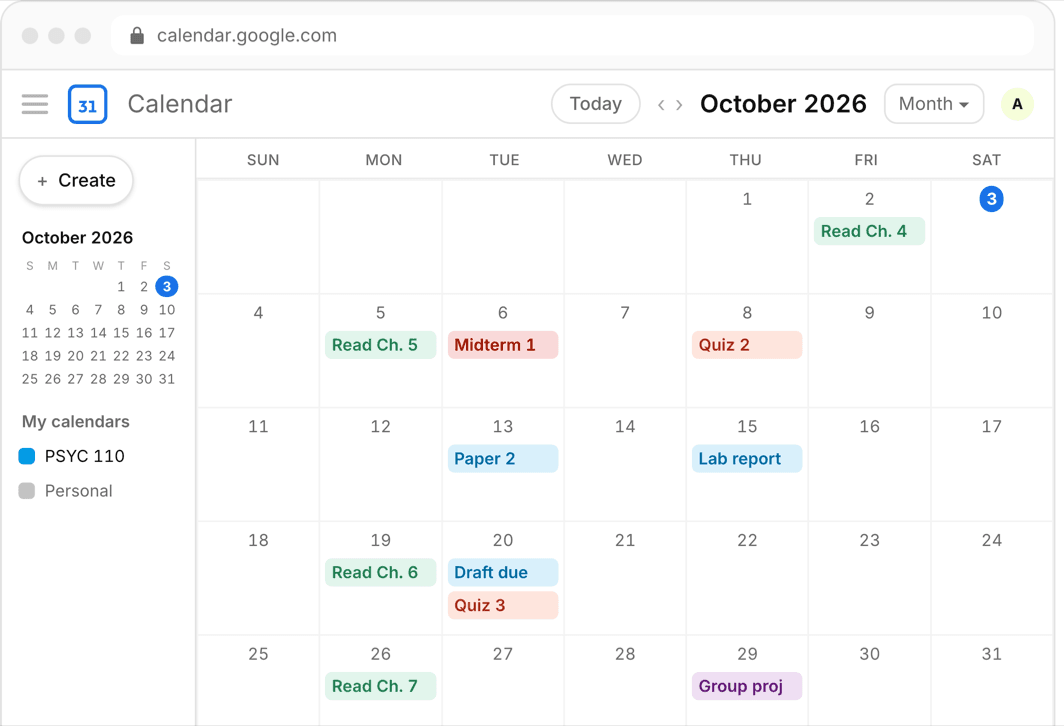
Transferring is a full systems reset wearing the costume of a routine enrollment. Your credits, your degree math, your financial aid, your advisor, your portals, even the definition of “late work” — all of it changes at once, and the new school processes you through it with the enthusiasm of a DMV. The students who lose semesters in a transfer almost never lose them in the classroom; they lose them in the paperwork.
This checklist covers the three battles that matter — credits, advising, and rebuilding your systems — roughly in the order they’ll hit you.
Or skip all of it
Upload the syllabus. Get the calendar.
Every assignment and exam on Google, Apple, or Outlook in about 30 seconds. One syllabus free, no account, no card.
Credits: audit the evaluation like money is on the line (it is)
Your new school will produce a transfer credit evaluation — the official ruling on what each of your old courses becomes. Read every line. The trap isn’t credits being rejected outright; it’s credits transferring as generic elective credit (“ELEC 1XX”) instead of counting toward specific requirements. Sixty credits that transfer but only fifteen that apply to your degree is functionally a year of repeated tuition.
Run your degree audit in the new school’s portal and compare it against your evaluation. For every course that came in as an elective when it clearly matched a real course, appeal: the standard process is submitting the old course’s syllabus to the relevant department for review. Dig up your old syllabi now — download them from your previous school’s LMS before you lose access, because you will need them and they get harder to retrieve every month.
Advising: get a human ruling before you register
- Book an appointment with your new academic advisor before your first registration window — not after. Registering from guesswork is how transfers take courses that duplicate transferred credit or miss a prerequisite chain.
- Bring three questions: Which requirements did my credits actually satisfy? What’s the longest prerequisite chain between me and graduation? What must I take this semester to stay on my target graduation date?
- Get your expected graduation date stated explicitly and recheck it after any appeal resolves. “On track” means nothing until someone shows you the math.
- If your major has its own advisor (many departments do), see that person too — degree-requirement rulings from the department beat generic advising-center answers.
- Ask about residency requirements: most schools require your final 30–60 credits be earned at the new school, which caps how much transferring can accelerate you.
Money and logistics: the unglamorous middle
- Financial aid does not transfer — it’s re-awarded. Confirm your FAFSA lists the new school, and check what institutional scholarships the new school offers transfers (many have transfer-specific money nobody advertises).
- Verify enrollment status math: if credits are still under appeal, make sure your course load keeps you full-time for aid, insurance, and housing purposes.
- Close out the old school completely: final official transcript sent after grades post, account balances cleared (an unpaid $40 fee can hold your transcript hostage), and loan exit paperwork if applicable.
- Handle the boring access items in week one: new student ID, parking or transit pass, LMS login, school email — and start actually checking that email, because every official notice now goes there.
- Confirm registration holds are cleared (immunization records, orientation modules, advising holds) well before your window opens. Holds surface at the worst possible moment by design.
The systems reset nobody warns you about
Here’s the part checklists usually skip: you’re not a freshman, but your operational knowledge just got zeroed out. Your old school’s rhythms — when things were due, how professors communicated, where you studied, who you texted for notes — none of it came with you. Transfers often stumble their first semester not from harder courses but from running old assumptions: a different LMS, different late policies, different add/drop dates, a registration system that works nothing like the one you knew.
So deliberately rebuild: read each new syllabus like a foreign document (policies will differ from your old school’s defaults), find the new add/drop and withdrawal deadlines and write them down, locate your study spaces, and rebuild your deadline system from scratch for the new environment. Treat your first semester as a calibration semester — schedule slightly below your max load if you can afford to, and use the margin to learn the school.
The social restart, and your first-week setup
Socially, you’re a freshman with none of the freshman infrastructure — orientation bonding mostly targets first-years, and everyone else’s friend groups formed years ago. Borrow the freshman playbook anyway: transfer-specific orientation events and transfer student orgs (instant peers with your exact situation), one or two recurring clubs, and a contact in every class by week two. Recurring beats one-off; organizing beats waiting.
And on the systems front, give yourself the fast version of the reset: drop each new syllabus into Classmaite and every deadline lands on your calendar in about 30 seconds — one less system to rebuild by hand.
Frequently asked questions
How do I know if my credits transferred correctly?
Compare your official transfer credit evaluation against your degree audit in the new school’s portal. Every course should map to a specific requirement, not just generic elective credit. If a course you took clearly matches a required course but came in as an elective, appeal with the old syllabus.
Can I appeal a transfer credit decision?
Yes — nearly every school has a re-evaluation process, usually run by the department that owns the equivalent course. Submit the old course’s syllabus (and sometimes assignments) showing the content matches. Appeals succeed often enough that it’s always worth filing for any wrongly-classified course.
Does financial aid transfer to a new school?
No — aid is awarded by each school, so it must be re-established. Update your FAFSA to list the new school, expect a new aid package that may differ from your old one, and ask about transfer-specific institutional scholarships, which many schools offer but few advertise.
Do transfer students graduate on time?
They can, but credit loss is the main risk — credits that transfer without applying to degree requirements quietly add semesters. Transfers who audit their evaluation, appeal misapplied credits, and meet an advisor before first registration are in the group that stays on schedule.