What Is a Course Catalog? How to Actually Read and Use One
Quick answer
A course catalog is a college’s official publication listing every course the school offers — with descriptions, credit hours, and prerequisites — plus the complete requirements for every degree program. It’s the authoritative reference for planning your degree; the semester’s actual class times live in a separate document called the course schedule.
Drop your syllabus here
Every assignment, exam, and reading on your calendar in about 30 seconds. Free, no account.
PDF, Word, or a photo of a paper one. No syllabus handy? See a sample
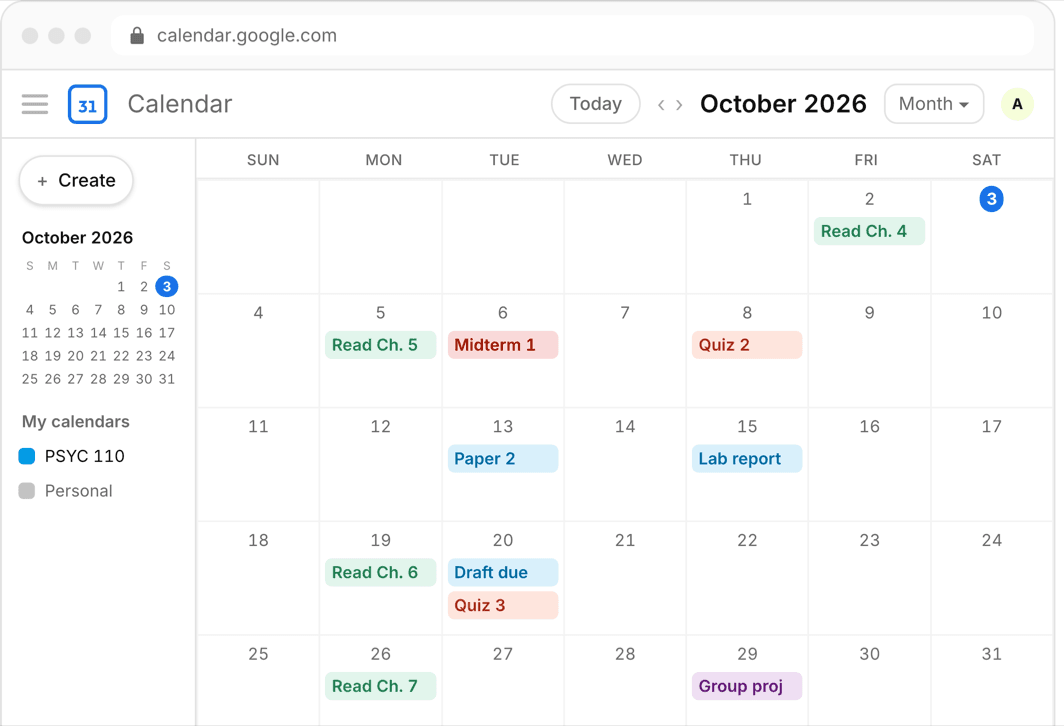
Every school has one document that answers “what does it actually take to graduate?” — and most students never read it. The course catalog is the official, binding description of every course your school offers and every requirement your degree demands. Advisors read it for you and summarize; students who read it themselves catch things advisors miss and plan semesters nobody has to fix later.
Here’s what the catalog is, how to decode its listings, and how to use it the way the top planners do: as the blueprint for your entire degree.
Or skip all of it
Upload the syllabus. Get the calendar.
Every assignment and exam on Google, Apple, or Outlook in about 30 seconds. One syllabus free, no account, no card.
Catalog vs. schedule: two documents students confuse
The catalog is the reference book: everything the school offers and requires, updated once a year. The course schedule (or timetable) is the live listing for one specific term: which of those courses are actually running, at what times, with which professors, and how many seats remain. You plan your degree from the catalog; you build each semester from the schedule. A course existing in the catalog is no promise it runs this term — some courses run only in fall, only in spring, or only in odd-numbered years, and the catalog listing usually says so.
One more distinction with real stakes: your catalog year. Degree requirements change over time, and you’re generally held to the requirements from the catalog in effect when you entered (sometimes with the option to move to a newer one). That specific catalog is effectively your contract with the school — when a requirement question gets contentious, its text is what settles it.
Decoding a course code
Every course has a code like PSYC 301: a subject prefix (which department owns it) and a number (roughly, its level). The numbering convention at most U.S. schools: 100-level = introductory, 200-level = intermediate/sophomore, 300–400-level = advanced undergraduate, 500+ = graduate. It’s a difficulty and prerequisite signal, not a strict law — but if you’re a freshman eyeing a 400-level course, the number is warning you.
A full catalog listing packs more in: “PSYC 301 — Cognitive Psychology (3 credits). Examines attention, memory, and decision-making. Prerequisite: PSYC 101 with C or better. Offered fall and spring.” That one entry tells you the department, level, workload in credit hours, content, the gate you must pass first, and when you can actually take it. Some listings add section-letter conventions, cross-listings (“same as NEUR 301” — one course, two departments, counts once), and GE attribute tags showing which general-education box it checks.
The requirements section: where degrees are actually defined
- Degree requirements — for every major: the exact required courses, elective rules (“choose three from the following list”), minimum grades, and total credits. This, not the marketing page, is the real definition of your major.
- General education requirements — the categories every student must fill (writing, quantitative reasoning, sciences, humanities) and which courses satisfy each. Courses that check two boxes at once are the great inefficiency-killers of degree planning.
- Academic policies — grading scales, repeat rules, academic-standing thresholds, residency requirements (how many credits must be earned at this school). The fine print that answers most “can I…?” questions.
- Minor and certificate requirements — often just 15–18 credits; the catalog is where you discover a minor you’re accidentally three courses away from completing.
Using the catalog to plan a degree (the part worth an afternoon)
Here’s the exercise that separates students who graduate on time from students surprised in senior year: take your major’s requirement list, map every prerequisite chain, and rough out all remaining semesters — not in detail, just which requirement gets satisfied when. Chains are the constraint: a four-course sequence takes four semesters minimum, so chain courses get scheduled first and electives fill around them. Note every “fall only” and “alternate years” tag as you go; those courses are your scheduling landmines.
Then optimize: find the double-counters (one course satisfying a GE and a major requirement), check whether your electives quietly complete a minor, and bring the draft to your advisor to pressure-test. An afternoon with the catalog turns advising meetings from “what should I take?” into “here’s my plan — what am I missing?” — a much stronger position.
From catalog to calendar
The catalog plans your years, the schedule builds your semesters — and then each course’s syllabus governs your weeks. That’s the full planning stack: catalog for the degree, schedule for the term, syllabus for the day-to-day.
Classmaite covers that last layer: upload each syllabus and every assignment, exam, and reading deadline is on your calendar in about 30 seconds — first one free.
Frequently asked questions
What is the difference between a course catalog and a course schedule?
The catalog is the annual reference listing every course the school offers plus all degree requirements. The schedule lists what’s actually running in one specific term — times, professors, and open seats. Plan your degree from the catalog; register from the schedule.
What do course numbers like 101, 201, and 301 mean?
They signal course level: 100-level courses are introductory, 200-level intermediate, 300–400-level advanced undergraduate, and 500+ typically graduate. Higher numbers usually mean more prerequisites and deeper material, though exact conventions vary slightly by school.
What is a catalog year and why does it matter?
Your catalog year is the edition of the catalog whose degree requirements you’re held to — usually the one in effect when you enrolled. If requirements change later, you generally keep your original set, which is why advisors always ask for your catalog year before answering requirement questions.
Do all courses in the catalog get offered every semester?
No — the catalog lists everything the school can offer, but many courses run only in fall, only in spring, or in alternate years, and listings usually note this. Always confirm in the term’s course schedule, and plan rare courses early since missing one can delay a prerequisite chain a full year.